
Table of Contents
Unpacking the way forward for work / insights into the gig financial system workforce
Jazz period musicians might have coined the phrase “gig” once they raised their devices at speakeasies, however getting paid on a per-job foundation for part-time work wasn’t new then, and it isn’t new now.
The laundress who took in wash over a century in the past. The child mowing yards all summer season. The freelance guide doing taxes on the aspect. The temp worker filling a short-term manufacturing job—it’s all gig work.
Gig work quietly churned as barely decipherable financial white noise for many years. Its monetary influence for employees was actual and put meals on the desk and plumped wet day financial savings. But it surely took expertise—particularly the web—to supercharge, modernize and legitimize gig work, in the end creating the gig financial system.
Early internet-based, tech-platform pushed corporations like Uber and Lyft, that disrupted the standard transportation mannequin by participating folks from all walks of life and attractive them to earn cash utilizing underutilized property they already owned, sparked a phenomenon that’s grown to have interaction 60 million folks.
To get right here, trendy gig employees transported not solely folks, however dinner, groceries and no matter else they wanted from a retail retailer to their house. The COVID-19 pandemic shut issues down; office conduct and places modified; and the inhabitants grew more and more cellular—all of which catapulted the recognition of gig work.
At the moment, the gig financial system is an umbrella time period damaged into subsets like “sharing financial system,” “on-demand financial system” and “platform financial system.” It’s a channel mechanism that successfully and effectively hyperlinks gig employees and clients.
And it’s BIG! It’s financial estimate is $1 trillion yearly within the U.S. with a median development fee of 16-17 p.c (aggregated consensus from a number of sources). Projections say 100 million gig employees will pursue primarily part-time revenue utilizing pay-for-performance standards by 2027.
However to be clear, gig employees actually aren’t simply shuttling folks to the airport or delivering dinner any longer. They seemingly by no means have been.
“The gig financial system could be very broad, and that’s one of many explanation why we really feel it behooves examine. As a result of generally we expect we perceive, however there’s a lot extra to it,” John Fleming, long-time advocate of the direct promoting trade, creator and founding father of the Final Gig Venture, shared.
Fleming and Dr. Robert A. Peterson, a former Vice President of The College of Texas at Austin, who holds the John T. Stuart III Centennial Chair in Enterprise Administration and served on an advisory committee to the U.S. Census Bureau, got down to uncover extra in regards to the gig financial system. Their efforts, The Way forward for Work: Insights Into the 2023 Gig Economic system Workforce, can be found now.
Who’s within the Gig Economic system. And Why.
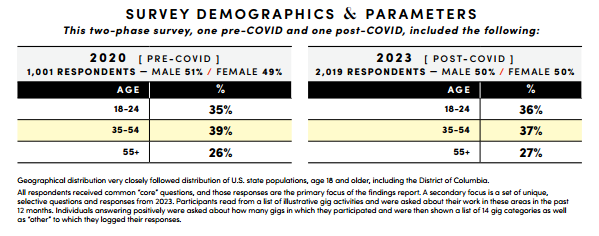
Two surveys of self-identified gig employees—carried out by the Final Gig Venture, the primary in 2020, pre-pandemic with 1,001 respondents and the second, post-pandemic in 2023 with 2,019—supply perception into the employee pool’s range; the work they carry out; and their earnings expectations and spending habits. Linear traits have emerged displaying the various nature and speedy development of the gig financial system itself, which have main implications for enterprise, authorities and society.
That is the one identified gig employee examine—stretching past very outlined subsets, like Uber, Lyft or 1099 employees—to incorporate a number of classes inside the gig financial system. Further surveys are anticipated in late 2024.
“After we do analysis, we aren’t making an attempt to offer solutions as a lot as we are trying to stimulate considering,” Fleming defined. And The Way forward for Work: Insights into the 2023 Gig Economic system Workforce offers the direct promoting trade a terrific deal to mull over.
So, who’re the gig employees main this gig financial system? What do they do and what do they need? And the way may direct promoting greatest capitalize on this phenomenon?
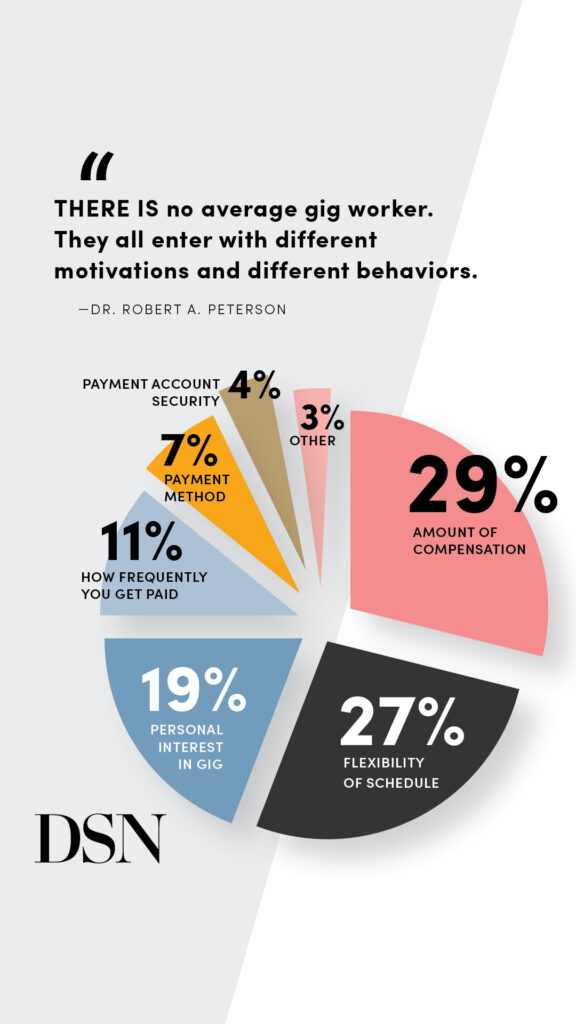
“There isn’t any common gig employee. Individuals speak in regards to the financial system. Sure, it’s on the market. It’s a trillion {dollars}. Sure, we’ve obtained 60 million folks, however there’s no common gig employee. All of them enter with completely different motivations and completely different behaviors, so there are completely different subsets. They’re in there for various causes,” Dr. Peterson mentioned.
The youngest gig employees, 18-34, are doing deliveries, incomes additional spending cash. Family payments will not be a precedence for his or her paychecks. However these midlife gig employees, 35-54, now depend on gig work to satisfy family payments. And that’s a particular change since 2020, when most gig employees socked earnings away for retirement, financial savings or investments. The over-55 group tends to love their gig—in order that they stick with it. For them, it could be much less in regards to the cash and extra about staying lively.
Gig employees report satisfaction with the pliability and freedom related to the work in addition to the pay, reporting that earnings exceeded their expectations upon coming into the workforce. And so they have a tendency to stay round, too.
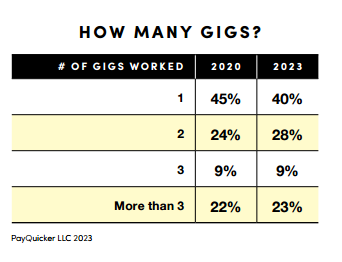
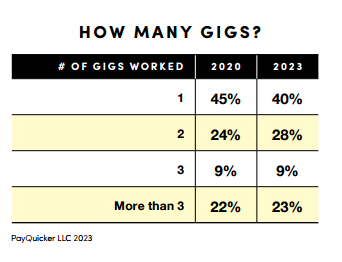
The starkest change between 2020 and 2023 was within the variety of gigs during which these employees take part. One was sufficient three years in the past, however as we speak it’s widespread for folks to take part in a number of aspect hustles, whereas sustaining an identical variety of work hours. Meals supply gigs have practically doubled. This means a change within the construction of the gig financial system, in addition to an opportunistic work drive. The norm is now three or extra gigs.
Sixty p.c of individuals now work a number of gigs, which Fleming mentioned is probably going the results of a pair issues: mastering the work and wanting extra of it or branching out to comparable work as a result of they’ve flexibility and freedom.
Whereas gig financial system predictions get dicey, as we speak’s actuality is that individuals proceed to hitch its ranks. However Dr. Peterson warns that present development charges can’t go on endlessly.
“Simply mathematically, because it grows greater, it’s obtained to additionally develop slower. As a result of there’s a restrict by way of the variety of folks which might be on the market within the inhabitants. So, for those who take a look at a cap of 100 million folks as potential gig employees (2027 projection), that could be it. And once we get to that, we’ll see a plateauing by way of development.”
Capitalizing on the Gig Work Phenomenon
This appears to point a timeliness issue related to how greatest to make the most of gig workforce information inside the enterprise world and contained in the direct promoting trade.
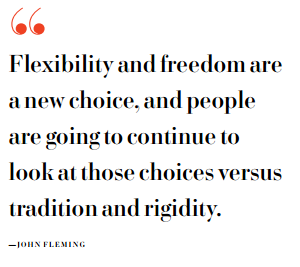
“Alternative is prevalent, and there are such a lot of decisions on the market. It’s one of many issues that we should always take note of as a result of the standard, industrial-economy work ethic has modified, and employers are discovering it increasingly more troublesome to get folks right into a nine-to-five job. Flexibility and freedom are new decisions, and individuals are going to proceed to have a look at these decisions,” Fleming defined. “Direct promoting practitioners actually need to concentrate to that as a result of it would result in redefining how and what we provide.”
For years, the direct promoting trade has watched the gig phenomenon develop, believing that direct promoting was one thing greater than a gig—which it arguably is. However misunderstandings in regards to the breadth and depth of the gig financial system might have stopped direct promoting’s resolution makers from totally capitalizing on the gig work phenomenon. In spite of everything, as we speak’s gig employee, as outlined by this new analysis, might be direct promoting’s latest prospect.
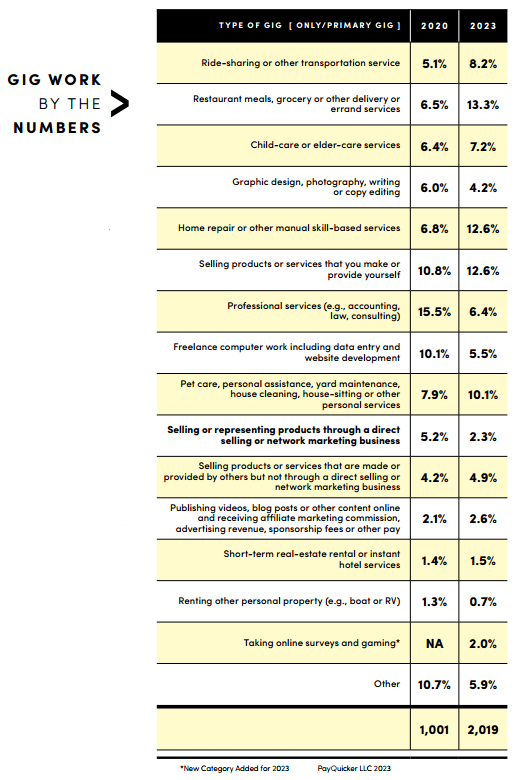
Within the 2020 survey, six p.c of self-identified gig employees declared themselves to be direct sellers. That quantity is now down to a few p.c. Why?
“From our viewpoint, direct promoting is a subset of the gig financial system. So, it’s not a matter of ought to direct sellers change into gig employees? They’re gig employees. When you take a look at the broader definition, the gig financial system contains impartial contractors in many various codecs. However generally we slim that definition an excessive amount of in accordance with our personal notion,” Fleming mentioned.
Direct promoting’s greatest problem might be in positioning itself as extra related within the market. The trade presents extraordinary services, however relevance can be about notion. And that, Fleming believes, is the trade’s huge alternative.
Companies like Upwork are rising as a result of folks from all walks of life wish to be in additional management of their work. That mirrors direct promoting. However would these Upwork gig employees—who prioritize flexibility and freedom—actually reply to “profession” pitch messaging? Do self-defined gig employees desire a “profession”? May direct promoting’s “profession” messaging want an replace to draw a brand new type of prospect?
Relevancy. Achievement. Notion.
The gig financial system has all however ignored profession earnings speak. But it has given individuals who need to put in additional time the power to earn extra. The satisfaction fee is excessive amongst gig employees. Individuals love what they do and there’s no over promise.
Lower than 10 p.c of gig employees are serious about career-type incomes, which begin roughly at $2,000/month. An ideal proportion are glad with $300, $400 or $500 per 30 days, as long as they’re able to work when and the way they need.
And with expertise making it a lot simpler for folks to take action many issues within the gig financial system, why shouldn’t direct promoting be a kind of gigs? May it’s time to shake out the complexities and a number of gig restrictions in direct promoting and simplify?
“If we consider we’re that good—and I actually suppose we’re—then maybe we have to take a look at repositioning our proposition—possibly talking a bit of in another way about who we’re and what we do in addition to taking steps to get rid of the adversarial attitudes that many segments have for the best way we conduct enterprise,” Fleming mentioned. “The gig financial system doesn’t make guarantees. They mainly give you a risk, and then you definately change into engaged. Then they reward you on efficiency. It’s actually as much as you. When you do the work, you’re going to receives a commission. And this gig financial system has triggered how we take into consideration all types of work.”
And it’s that kind of wide-spread disruption that creates alternative for the direct promoting trade. Direct sellers might argue that they have been the primary gig employees. On paper, the “why”s of so many direct sellers—flexibility, time freedom, earnings potential—learn like a gig work must-have checklist.
To be one of the best at buyer acquisition and retention in a market that calls for it, but failing to compellingly convey that story—when there’s a lot potential—is a contradiction and problem value exploring. If direct promoting, as a subset of the gig financial system, can simplify and simply present gig prospects the combination advantages from the purchasers they assist affect and purchase who then proceed to buy the merchandise, it might solely achieve floor.
“We have now a lot room to enhance and place ourselves, so the general public—{the marketplace} if you’ll—can higher perceive who we’re; what we do and the way a lot we have now to supply,” Fleming mentioned.
Defining the Gig Economic system and Its Individuals
Rising 4 instances sooner than the standard financial system, gig work and gig employees are evolving. The will for flexibility and freedom is powerful and new analysis signifies the one actual commonality is the necessity for extra cash.
The Way forward for Work: Insights into the 2023 Gig Economic system Workforce offers a glimpse at a various and ever-changing employee group. Listed here are some key factors to ponder from that not too long ago printed analysis.
- No particular gig exercise dominates the gig financial system. Fewer than 1-in-12 pursued a platform-based journey sharing gig in 2023.
- On-line platform-based gigs are only one section, regardless of attracting the vast majority of media consideration.
- Feminine gig employees count on to earn lower than their male counterparts (and do). The underlying causes are quite a few, advanced and explainable.
- Regardless of the necessity for more cash, a not insignificant proportion of the gig workforce engages for causes not related to pay.
- There’s little distinction between major and secondary gigs for many who pursue a number of gigs by way of the character of the gig, time spent or earnings acquired.
Wish to study extra? View the total report, sponsored by PayQuicker.

What You Ought to Be Asking Your self and Your Group
1/ What does work appear to be sooner or later? Flexibility and freedom have rather a lot to do with how folks need to dwell and relate to their households. How may direct promoting higher meet societal expectations and change?
2/ The gig financial system is a phenomenon that doubled between 2018 and 2023. Why has the gig financial system outpaced direct promoting since 2015?
3/ Gig employees are common People. Who they’re; how they take part; what number of gigs they work; their earnings expectations; and the way they spend their cash can affect how direct promoting corporations recruit them. Ought to direct promoting modify its messaging? In that case, how?
4/ Why do 60 p.c of gig employees take part in a number of gigs? They pursue flexibility, freedom, work/life stability and earnings to satisfy family bills. Can direct promoting assist meet their wants?
5/ Direct promoting is a subset of the gig financial system however captures solely three p.c market share. How may direct promoting enhance and place itself to achieve market share? Is it value it? Can direct promoting concurrently supply gig work and a profession alternative?
From the September 2023 problem of Direct Promoting Information journal.